Nevertheless, let's get on with it!
Just Mercy has been a really good book. It's given me a lot of insight into a lot of issues in our criminal justice system, our prisons, and our government.
It's also challenged my ideas about racism and education.
Ever since I finished Just Mercy, I've been thinking about a few things. First of all, why is it, even in our modern society today, do we still deal with so many problems concerning race and discrimination?
We have created a reality where cars can drive themselves, information is available freely over the internet, and where almost all countries have stable governments. But we still somehow can't get over the fact that although all of us are scientifically proven to be 99.99% alike (this is actually a real fact), just because one or two genes are changed in some of us, that's deserving of different treatment (Phillips)?
Note: we actually have six billion bases of human DNA in our genome, and only .001 out of 1 or .1% of those are different for random reasons (Phillips).

- Visualization of 1000 dots, each dot is .1% of the whole (Urban).
I don't really want to get into the human condition - but one thing is certain. No matter how much our society praises knowledge and education, at our root, we are not purely logical beings. What we may call logic is just a complex set of electrochemical circuits in our brain designed to connect sights, sounds, and smells for split-second processing.
However, I don't want to be too nihilistic. Ultimately I do believe that we can change our biases to see past races like we do with so many other things. We have to overcome our own wiring and control our biases and emotions. So although we still may be in some way neanderthals who still are afraid of anyone who looks different, in many more ways we can get rid of any biases, just like, while 10,000 years ago, it was normal to be scared of the dark, many people now in a modern world just aren't.
While I was reading Just Mercy, I noticed two big patterns that I thought might be the key to understanding how we can create a less biased and racist world.
In Just Mercy and a lot of other texts we've recently read, I noticed that fear, confusion, and ignorance were almost always behind what we called "racism."
I think maybe this is actually why Stevenson choose to write Just Mercy. By recalling all of his experiences with racism, he shows that racism is real and that we can do something about it. Through this, he helps to undo the reader's ignorance of racism (in the criminal justice system).
Ignorance of racism creates racism. This is a key idea in Just Mercy. Walter is put in jail for something he didn't do. I'd like to think many other townspeople would have liked to help Walter if they had really thought he was being put in prison for a discriminatory reason, but they simply didn't see anything, for them, which was out of the ordinary, so for them, they didn't really do anything about it.
Only later, when Walter's case airs on 60 Minutes, do a lot of local townspeople and media put pressure on the court to give Walter another chance at freedom.
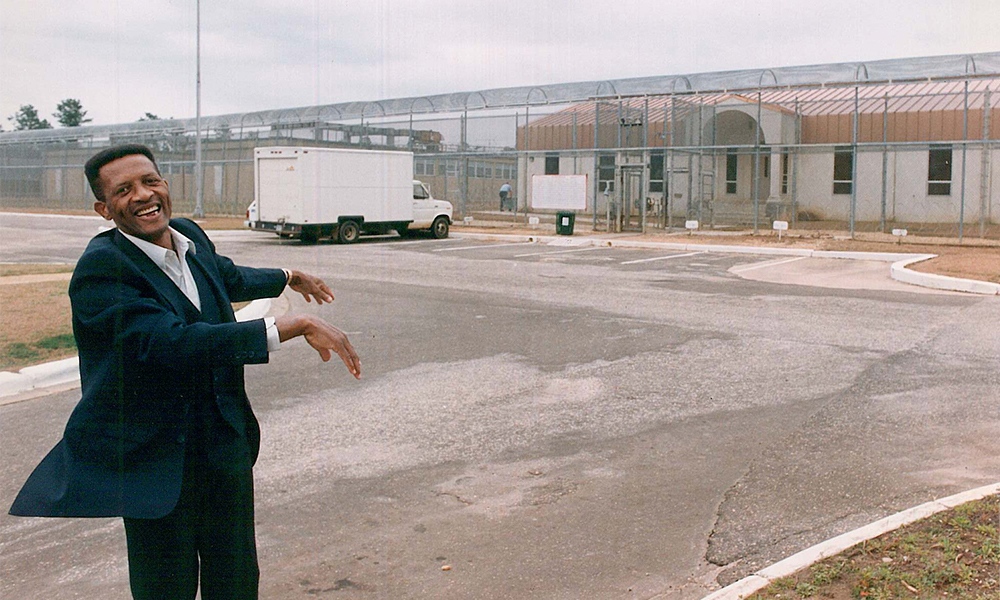
- A real picture of Walter. That face is not of a guilty man (Walter).
Although Walter's town wasn't racist in the usual sense, their comfortability with their surroundings and lack of interest in helping Walter enabled real discrimination.
In the New York Times article we read earlier this year, one girl said how she felt her first contact with racism was when a friend came over and disregarded her traditions and didn't eat her family's food (Youth Radio Oakland).
Although maybe this friend shouldn't have felt compelled to take part in all of these traditions, not paying attention may cause racism just as much as being directly racist.
Being informed is something very easy to do today and it is probably the best way for us to stay updated about any recent issues and to form our own opinions. Participating in and acknowledging big events in your local community is a great way to prevent discrimination. If Walter's community had only followed his case from the beginning - stepping outside what the news articles were directly saying, his case wouldn't have been a problem.
Unfortunately, at the same time, being informed today is becoming harder and harder to do. We are living in a computer age where almost everything published is dumbed down or written to appeal to a specific audience. There is almost no such thing as bias-free writing today. Everything from an online newspaper article to a Wikipedia summary has pop-ups and ads all begging to be clicked on by a target audience. Unfortunately, that means discussion and critical analysis are our most important tools to reduce ignorance.
Ok, onward.
The idea of fear enabling racism I also noticed throughout this unit. Everything from Just Mercy to Whistling Vivaldi has this idea embedded somewhere.
In Whistling Vivaldi's fear is what causes a wary look at anyone at night who seems frightening (Steele).
Racism emerges on the streets late at night - when everything becomes biases and reaction time
In Just Mercy, the plaintiff's horrifying images of Walter unlocks fear in the jury's minds.
Walter's initial ruling makes him feared, which only gives more reason to Sheriff Tate and the Judge to do whatever they can to make his sentence worse. Fear and racism go hand and hand.
Racism creates fear, which sparks more racism.
I think education is a big part of reducing fear. We were afraid of water until we could swim. We were afraid of riding a bike until we rode a bike. We were afraid of math until we did algebra (maybe some of us still are :)
Fear is independent of logic and thought. Although we are emotional beings, specific education about different communities will go a long way to reducing irrational fears, and hopefully, improving the lives of many and reducing racism and discrimination.
Overall, without Just Mercy, I for sure wouldn't have touched on these ideas. Just Mercy has brought my understanding of racism in our court system a long way. In fact, when I first read the first chapter, I couldn't really tell if Stevenson was exaggerating a lot of details about Walter's case. It was so absurd, it was hard to believe! Only once I started learning more about how brutally racist our criminal justice system was, and to a much smaller extent, has been, I was able to understand Walter's story.
However, I think Just Mercy requires a specific type of reader. I do not believe that Just Mercy is a book intended to overload you with facts and shove an opinion about you. I think Stevenson hopes that through a reader's careful analysis of many unfortunate situations on death row, they will be able to develop their own strong and ethical ideas about race.
Hopefully, this opinion will lead a reader to pursue combatting inequality in their own community.
Sources
Just Mercy: A Story of Justice and Redemption. First edition.
New York: Spiegel & Grau, 2014.
Phillips, Elizabeth M et al. “Mixed Race: Understanding Difference in the Genome Era.”
Social forces; a scientific medium of social study and interpretation
vol. 86,2 (2007): 795-820. doi:10.1093/sf/86.2.795
Steele, Claude. Whistling Vivaldi: And Other Clues to How Stereotypes Affect Us.
New York: W.W. Norton & Company, 2010.
Urban, Tim. Visualization of 1000 dots. Wait But Why,
waitbutwhy.com/2014/11/from-1-to-1000000.html. Accessed 24 Apr. 2020.
Walter Laughing. Equal Justice Initiative, Equal Justice Initiative 2020,
eji.org/cases/walter-mcmillian/. Accessed 24 Apr. 2020.
Youth Radio Oakland. "First Encounters With Racism" ["First Encounters With Racism"].
The New York Times, New York Times Company, 2 Aug. 2017,
www.nytimes.com/2017/08/02/us/first-encounters-with-racism.html.
Accessed 24 Apr. 2020.