At the beginning of Just Mercy, we saw how Walter was burdened by inequality and sentenced to die for a crime he didn't commit. Then, we witnessed how racism and discrimination affected Walter's community - and the black community as a whole.
But in these last few chapters, Stevenson changed gears. He introduced a lot of new characters, like Walter, Trina or Ian, who were his former clients and takes a look at Ralph Myer's highly anticipated testimony in Walters's trial.
At first glimpse - all of these people and ideas in this reading seem unrelated. What is Stevenson trying to do by introducing so many different topics in this last reading? What are these last chapters leading us, the readers, to? I think, more than anything, in these last few chapters, Stevenson is giving us a glimpse into why he wrote Just Mercy.
The first part of the reading focused mainly on the trials of many of Stevenson's former clients (who were all childhood criminals and are all serving life sentences). Stevenson discusses the implications of being a childhood criminal:
"Children who commit serious crimes long have been vulnerable to adult prosecution and punishment in many states, but the development of juvenile justice systems has meant that most child offenders were sent to juvenile detention facilities. Juvenile systems vary across the United States, but most states would have kept Trina, Ian or Antonia [his clients] in juvenile custody until they turned eighteen or twenty-one. AT most they might have stayed in custody until age twenty-five or odder... In an earlier era, if you were thirteen or fourteen when you committed a crime, you would find yourself in the adult system with a lengthy sentence only if the crime was unusually high-profile." (157)
All of the people Stevenson mentions here: Trina, Ian or Antonia: they all are sentenced to die. To die in a cell. To die for a crime they only committed as a teenager. To die for a reason that wouldn't have mattered if their judge hadn't been discriminatory, their background hadn't had been ruthless, or they had lived just miles away in a different state.
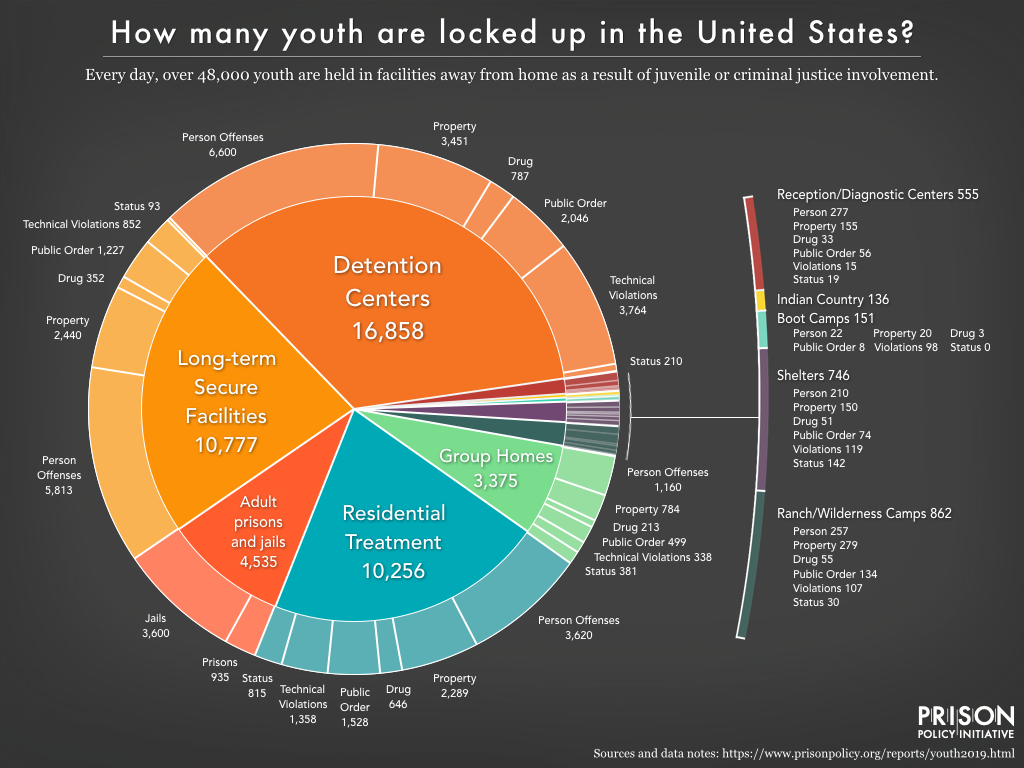
(A quick look into the very interesting and sad problem of youth confinement. Note that 10% of juvenile youth are locked in adult prisons - likely to life sentences)
This led me to what I got from this last reading. To me, what Stevenson is trying to do in Just Mercy is simple: he is trying to prove that inequality in the courts is real, it has been covertly done for many decades, and that fighting against inequality can make a difference.
There are two big parts to Stevenson's argument in Just Mercy. He exposes a faulty criminal justice system that does discriminate and treat people poorly. He also does encourage us to fight injustice ourselves, and that doing this does cause change.
The first part of Stevenson's argument is clear. He recalls stories like Walter's, Trina, or Ian's to show that we do live in a criminal justice system that isn't fair.
The second part of Stevenson's argument can be seen in Ralph's testimony in court. When Ralph testifies, everything is against him. He is uneducated and bullied by the legal system. Nevertheless, he prevails. Walter's case is much better off as a result. Through Stevenson's perseverance, he is able to put up a fight for Walter - and to beat the system.
This second part of Stevenson's argument is also exemplified at the end of the reading. In a surprising reveal at the end of the final chapter, a prison guard, who was previously mean to Stevenson, cries in front of him. The man is touched by Stevenson's work and sympathizes with and is passionate about helping a mentally ill patient Stevenson helped defend. Due to mental illness, this patient, Avery, has an obsession with having a chocolate milkshake. Stevenson is excited to hear when he enters Avery's cell that this guard did, in fact, bring him to Wendy's for his special treat.
"You know, I [The guard] guess what I'm trying to say is that I think it's good what you're doing. I got so angry coming up that there were plenty of times when I really wanted to hurt somebody, just because I was angry. I made it to eighteen, joined the military, and you know, I've been okay. But sitting in that courtroom brought back memories and I think I realized how I'm still kind of angry." (201)
We really do witness the effects of Stevenson's work in this chapter. He makes a difference, not only for his clients but also for the people who stand by them and watch them at a distance. Stevenson inspires these people to do right on their own. His argument, that injustice is real and that we can fight it very much from a patriotic sense rings true.
But actually how much can we do on our own to combat injustice? I think, surprisingly a lot. With more and more social media outreach for rallies and protests, we are entering an age where fighting injustice has become very real and very accessible. Stevenson's argument does resonate with me, and his perspective is well supported.
Works Cited
Works Cited
Just Mercy: A Story of Justice and Redemption. First edition.
New York: Spiegel & Grau, 2014.
Sawyer, Wendy. Youth Confinement Pie Chart. Prison Policy Initiative, 19 Dec. 2019,
www.prisonpolicy.org/reports/youth2019.html. Accessed 24 Mar. 2020. Map.

Theo, I liked your use of an infographic in order to back up your analysis. I think it adds depth to your post and makes it more interesting. However, I would have appreciated it if you could have explained in more detail how Ralph was "bullied" by the legal system. That caught my attention as an important plot point, and I'd like to know more.
ReplyDeleteGoing forward, what do you think are some first steps that we could take as a country to try and address our corrupt justice system?
-Spencer Burdette
This comment has been removed by the author.
DeleteThanks for your helpful comment Spencer. Ralph is a poor and uneducated Southerner who has a key role in my book Just Mercy. He is coerced into making up a false testimony against a local black man, Walter, who is disliked. Just like Walter, Ralph is bullied by the legal system, just for a different reason.
DeleteHow I think we can address our corrupt justice system is the same way we should approach reducing racism and discrimination. While affirmative action is sometimes thought of reverse racism and innately discriminatory, I think it could have a key role in reducing racism in the US and abroad. Even if society isn't as racist and discriminatory today as it was 50 years ago, there are still a lot of economic effects from the early 19th century when discrimination on the basis of race was legally codified. For example, black families still do, on average, live in poorer neighborhoods. So even if people of color aren't necessarily being discriminated today, the way they were treated in the past may put these groups in a certain proverbial "hole" of poverty that they can't escape from.
Affirmative action is really the best way to transition places like Hopkinton from a more homogenous society. Although this practice won't always be necessary - I think affirmative action for a lot of things: magnet schools, colleges and even jobs is one (almost socialist) way of "equaling the playing field" and exposing people (including people in the criminal justice system) to more diverse crowds. Although it may be somewhat discriminatory, affirmative action does have good intentions, and years from now will have more positive effects. As many generations go through affirmative actions and become more accepting, I think our legal system will follow. How do you feel about affirmative action, Spencer?
This post was really interesting. It's very unfortunate that we still have to fight injustice, considering how long we have been trying to get rid the problem. I'm really curious to see how this topic plays out in the future, and I really like your way of spacing out the different topics you address. You also made me understand what the author's argument is very clearly.
ReplyDeleteOverall, I really enjoyed this post and I might even pick up this book for myself!
You've done a nice job presenting your information and the ideas you got from the reading. I also appreciated the infographic.
ReplyDeleteDid you find this section of the reading more powerful than the others, since, in some ways, you have a closer connection to the people discussed in this section because of their age?
I think it was a really smart decision of Stevenson to include the stories of his younger clients. I for one, really connect with them because I still am learning a lot and I understand where these kids are coming from.
DeleteI think this idea really sums up Stevenson's argument in this chapter. Trina, Ian and Antonio were good hearted, innocent kids whose sentences were more just products of violence and discrimination in their neighborhoods than anything else. For them, one little mistake led to another - they got caught up in something they didn't want to do - and and before long, all three were going to prison.