This last reading has been a wild ride. Despite death threats and bad press, and through a series of remarkable legal decisions, Stevenson is able to grant Walter his freedom.
Walter is given a second trial and literally walks the courthouse steps, leaving death row behind!
But Walter's story doesn't end up all that happily. Due to years of prison abuse and neglect, Walter struggles to find a job to stay afloat - going back to work as a woodsman and later trying his luck as a car repairman on his front lawn. The very last thing Walter does in this reading is cry in front of reporters who are interviewing him about coming off death row. Walter breaks down about how his life was ruined by prison and by his trial.
Stevenson's main point with including this part of Walter's story is that part of our criminal justice problem has to do with our prisons. More than ever, I thought this was a good time to connect Walter's story to some current events.
We still live in a time where our prisons are brutal and misgiving - in many ways worse than the last decade.
"In the United States, the number of women sent to prison increased 646 percent between 1980 and 2010, a rate of increase 1.5 times higher than the rate for men. With close to two hundred thousand women in jails and prisons in America and over a million women under the supervision or control of the criminal justice system, the incarceration of women has reached record levels" (235-236)
Stevenson not only looks at the effects of prison on Walter in this chapter but also on another past client, Martha. Because of a legal complication, Martha is sent to a dangerous women's prison.
In the 90s, this statistic is at its peak - Martha's cell is overcrowded, especially with the mentally ill. She is mistreated for what should have been a mistrial.
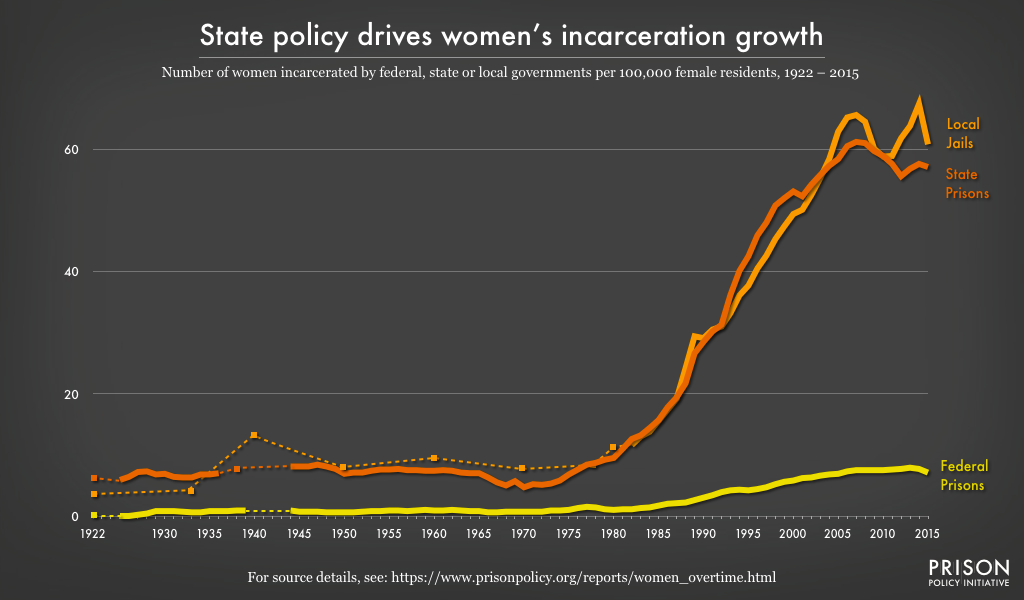
(Big rise of incarceration of women from Prison Policy Initiative)
Even today, the United States' prison situation is not much better. Incarceration rates in women's prisons have continued to spike since the 90s (seen above in a cooly designed graphically by a public policy initiative), especially for state and local jails, both of which are notorious for housing violent offenders (not white-collar and wealthier prisoners, who typically go to federal prisons). The prison situation for women, today, has grown in magnitude but also in seriousness.
Walter's problem of coming out of prison shocked and unprepared for society again is another key problem that existed in our prison system - and is one that still plagues our prison system. According to the University of Minnesota, still, only about 1/3 of prisoners that desire a degree or job certificate actually are able to work towards one. Out of 63% of prisoners that desire some kind of work certificate, only 21% are to even enroll in classes to make progress towards these kinds of goals.
This is really interesting. I think we really do consider ourselves a more progressive society than how we were back in the 90s. The thing is though, we really can't see on an everyday basis the injustice in our prisons. Prisons can be overcrowded and in poor condition - and without an advocator or an insider, the public would never know. Maybe this is why our prison system hasn't improved: because the general public and the people who are voting only see half of the issue.

(Interesting chart from the U of Minnesota showing education statistics for prisoners)
Our prison system is not designed to help inmates or to teach them, but to punish them. We have created a prison system that rewards brutality on inmates like Walter and Martha in the same ways that were going on twenty years ago. Not much has changed from Stevenson's allegory to today.
"Most people released from prison after being proved innocent receive no money, no assistance, no counseling - nothing from the state that wrongly imprisoned them" (244)
"Their punishments were humane, and their policymakers took rehabilitation of criminal offenders very seriously, which made me excited about the award and trip" (251)
But how can we fix our current prison problem? We are dealing with a whole different issue than Sweden. We have tens of millions of people being arrested for violent crimes, not tens of thousands.
Ultimately, fixing these problems will come down to conflict-prevention. We need to find ways to better educate more people, especially in poorer areas - and to reduce poverty and unemployment. We need to better fund schools and implement better prison rehabilitation programs to prevent more crimes before trying to stop them. So, maybe fixing prisons isn't that simple after all. But I think it can be done.
Works Cited
Clark, Jared. "Inequality in Prison" ["Inequality in Prison"].
Monitor on Psychology, vol. 40, no. No. 9, Sept.-Oct. 2009. American Psychological
Association, www.apa.org/monitor/2009/10/ recidivism. Accessed 30 Mar. 2020.
Just Mercy: A Story of Justice and Redemption. First edition. New York: Spiegel & Grau, 2014.
Phelps, Michelle. "Rehabilitation in Prison?" ["Rehabilitation in Prison?"].
Gender Policy Report, U of Minnesota, 21 Mar. 2017,
genderpolicyreport.umn.edu/rehabilitation-in-prison/. Accessed 30 Mar. 2020.
Sawyer, Wendy. State's Policy Incarceration Growth. Prison Policy Initiative,
9 Jan. 2018, www.prisonpolicy.org/reports/women_overtime.html.
Accessed 30 Mar. 2020. Infographic.

Hi Theo-
ReplyDeleteThis is a super interesting post. I wasn't really aware of the rising numbers of women who are being incarcerated, but I think it's something that should be a more mainstream topic. Issued within law reinforcement have been all over the place, but (unless I'm really oblivious) we don't hear or talk a lot about what happens within the walls of prisons or "correction centers". You tied Just Mercy to current events really well, using Stevenson's narrative about Martha as a really strong jumping off point. The graphs you include are great; they really give people a better idea of what you're talking about. Reading the numbers makes an impression but are hard to imagine, so I appreciate the visuals.
After reading this post, I feel much more informed and I'm curious about what you think is causing the rising numbers.
Theo, I liked the last part of your post where you explored what could be done to solve the problem(funding schools, prison rehabilitation). I think those solutions will actually be effective, as opposed to what politicians are suggesting, which is just more prisons and more arrests. Do you think our government is going in the right direction when it comes to this issue?
ReplyDeleteGood discussion of some of the problems that exist within our prison system, particularly with the lack of training and opportunity provided after people get out of prison.
ReplyDeleteWithout comparing the US prison system to that of other countries, do you think it is too much to say that we have one of the worst in the world? This is not to say there aren't problems, but are the problems in US prisons worse than those in other countries? I think we'd need more evidence to support that claim.
Hello Ms.LaClair,
DeleteSorry if I didn't make that distinction. I don't think I said but I might have incidentally implied the US has the "worst" prison system in the world (worst meaning the most brutal, least forgiving prison system in the world). In any case, I simple couldn't argue that this is true.
However, there are many developing countries who simply do not have the resources to invest in better living conditions for prisoners. These prisoners may not be mistreated by intent so much as they are mistreated by an underfunded system and poorly supported government. Countries like Venezuela and Vietnam are struggling in ways we can not even understand in the US, and while it is no means right to say that it is okay what they are doing to their prisoners, I do think we have to change our definition of "worst" when it comes to talking about prisons in the US - because frankly we cannot compare ourselves to many other countries abroad.
The facts are plain and simple. The US has a GDP per capita (wealth/people) ranked 13th in the world, only trailing Luxembourg, San Mario, UAE, Kuwait, Norway, Switzerland, etc. Many of these other countries are artificially supported by (relatively unsustainable) oil wealth. Oil and gas make up 8% of the US GDP, as compared to 18% of Norway's GDP for instance. Even when we do account for the number of people in our country, the US still has an economy that tops the world charts. In fact, my choice in my blog post to say we can't compare the US prison system to Sweden may not be justified. According to what I just read, our GDP per capita is even higher than Sweden's (Obviously how we manage our wealth and what we consider to be pressing issues are certainly different).
One way I'm going to look at is that "worst" does have variety of definitions. I think there is a viable argument to say the US does have one of the "worst" prison systems in the world - we just have to be careful how to define "worst."
The US does have one of the world's leading economies and at the same time, of the the most brutal prison systems. We have privatized prisons, the death sentence and juvenile sentencing. There are still a lot of remnants of civil rights issues in our court system. We admittedly and statistically do have the power to stop prisoner mistreatment, but we do not do so. In a lot of ways, this may be "worse" than what Venezuela is doing. If we are doing something and have the possibility to stop it and we make the choice not to stop doing it, is this worse than if the same thing is happening and we have no control over it? Maybe in this sense, we do have the "worst" prison systems in the world.
In fact, I may have been wasting my time on this comment. I probably need to finish writing my blog post -I will definitely have to stay up until 11 now :) - but this comment this is by no means complete - I think there still are a lot of ideas that could be developed from what I am claiming above. If you have any questions, we can continue to make this an ongoing topic.
Crude "citations"
https://www.energyindepth.org/report-details-how-oil-and-natural-gas-are-critical-to-the-u-s-economy/
https://ec.europa.eu/trade/policy/countries-and-regions/countries/norway/
Theo, I think this a really cool way of looking at this chapter! I also thought after reading this section that maybe there was another side to Stevensons argument. I was thinking that maybe, he was trying to reiterate that there are not only problems within the system, and in prisons and such, but also, those have a very strong relationship with the effects of the people that are released back into culture. Do you think this as well?
ReplyDelete